Topic 03
The Rust Belt and deindustrialization: where the name comes from and what happened
Detroit, which lies in the Rust Belt region, had a population of 1,849,568 in 1950 and only 639,111 in 2020, according to Census Bureau counts. The example shows how large the change was and why the region is still discussed today. How could industrial cities lose so many residents? The answer requires a look at the name, at the causes of deindustrialization and at what changed in the cities. We examine these three topics in turn.
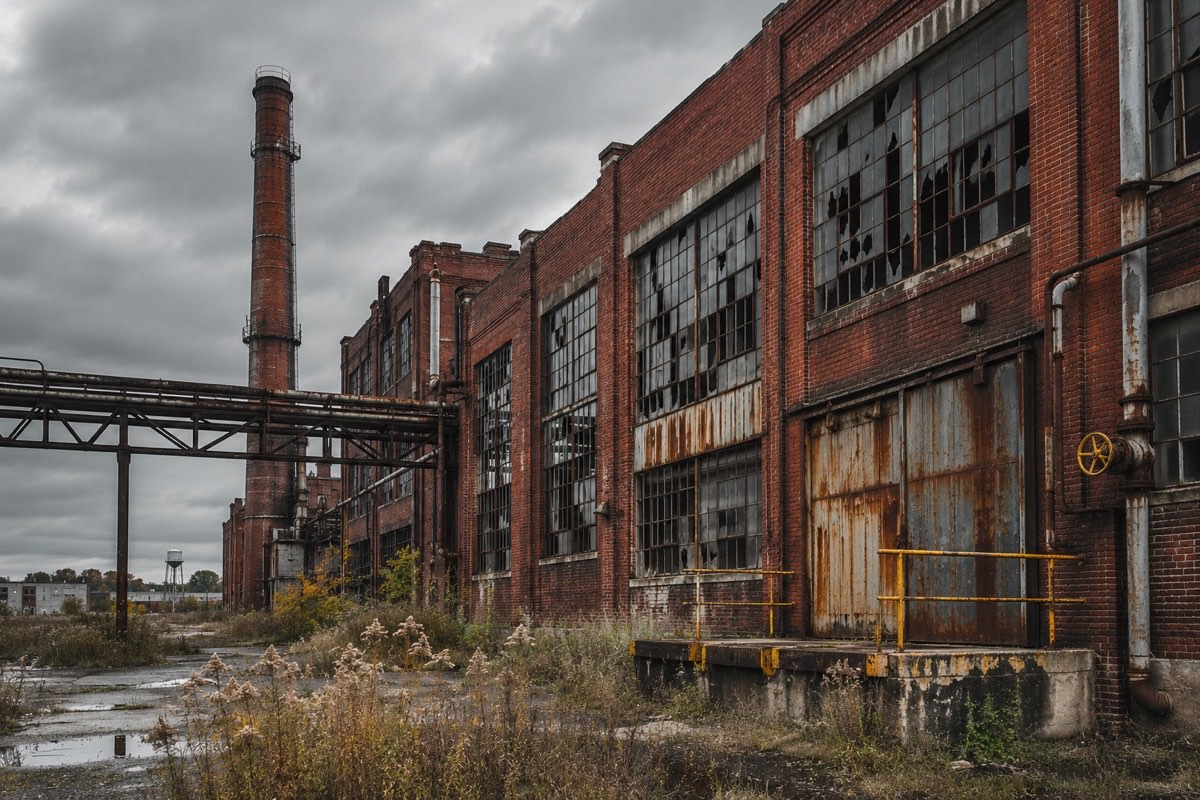
What is the Rust Belt?
The Rust Belt is a popular name for the industrial region of the northeastern and Midwestern United States. It usually includes Michigan, Ohio, Pennsylvania and Indiana. It is not an official term, so the borders of the region are drawn in different ways.
The name evokes rust, abandoned factories and idle machines. It is a metaphor, not a description of every city. The region still has places that have adapted and now function differently than before. The term therefore serves primarily as a reminder of former industrial strength, not a verdict on the whole area. It is worth keeping in mind when reading any such story, because a mental shortcut easily replaces analysis.
Deindustrialization: what happened to industry?
The reference point is 1979. According to BLS data, manufacturing employment in the United States peaked that year at an annual average of 19.4 million people. Since then deindustrialization has shifted the balance of the economy, and the decline of industry was clearly felt in many regions.
There is no single cause. Deindustrialization has many causes, such as automation, the relocation of production, shifts in demand, foreign competition and changes across the whole economy. These factors acted at the same time, so it is hard to point to one turning point. Each of them affected manufacturing employment differently, and their effects overlapped.
This variety of causes explains why deindustrialization did not look the same in every city. Automation can reduce the number of jobs, while the relocation of production takes work away from one particular place. The decline of industry therefore has to be described region by region.
How did industrial cities change?
Industrial cities felt deindustrialization on several levels. The first effect was depopulation, as Detroit shows: between 1950 and 2020 it lost more than half of its residents. The second was a fall in tax revenue, which limited the ability to maintain local infrastructure and services. The third was a change in the structure of employment, in which services played a growing role.
These changes are linked. Fewer residents mean lower revenue, and lower revenue makes it harder to rebuild the local economy in industrial cities. That is why the history of the region is today often discussed as an example of a long process, not a single crisis.
Where to find data about the region
The best place to start is the sources this text relies on: Census Bureau population counts and BLS employment statistics. They let you compare figures from different years yourself and judge the scale of change in industrial cities. Treat these statistics as a starting point for your own analysis of industry and its decline.